Skip to content

Estate Planning with A Revocable Living Trust
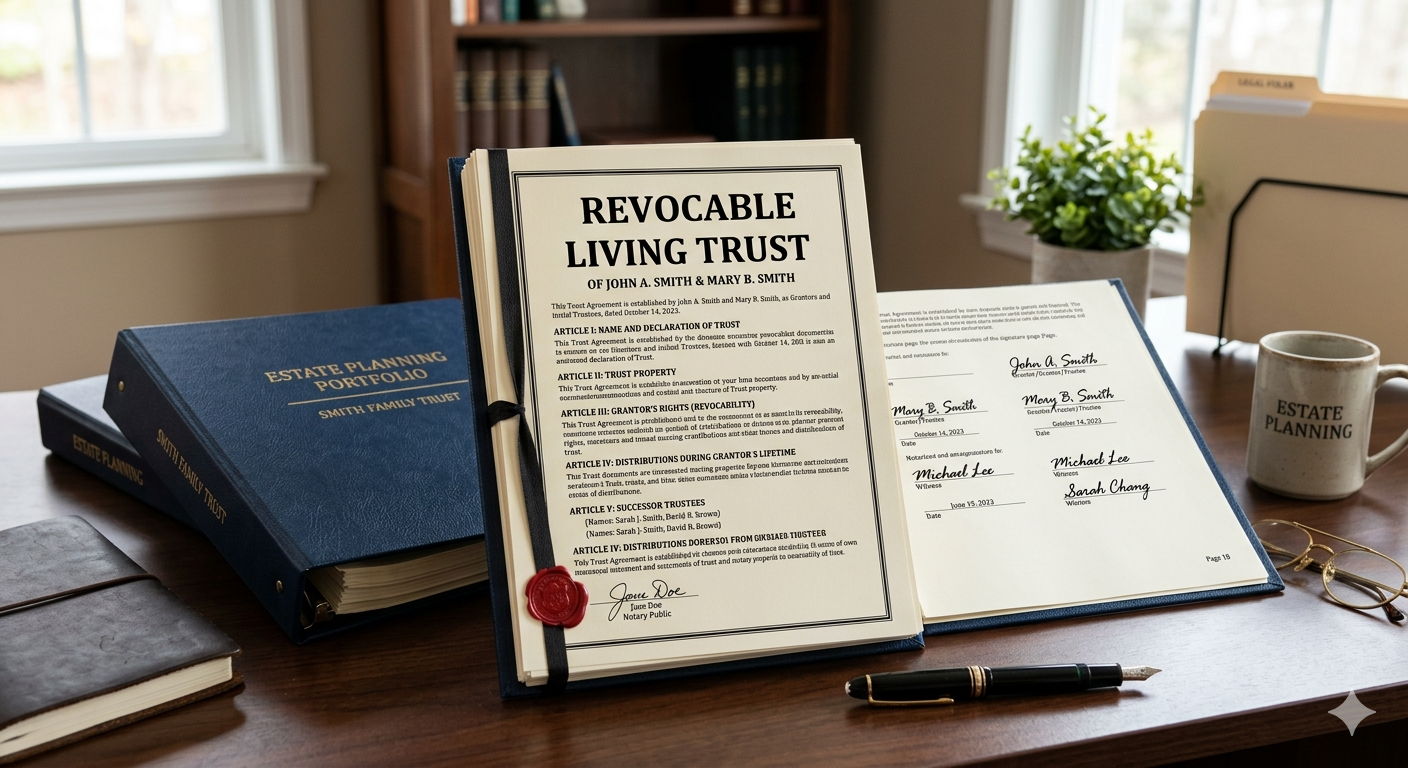
Revocable Living Trust

A Revocable Living Trust is a legal document that can accomplish a number of things for people who are interested in Estate Planning. Under the terms of the document, a person (usually called a "Settlor" or "Grantor") with transfer property to a person ("Trustee") to hold the property for the benefit of the Settlor. In most cases, the Settlor and the Trustee are the same person-- allowing the Settlor to have maximum control in the use and management of those assets.
The idea is that the Settlor will have unlimited use and enjoyment of the property during his lifetime, and upon the Settlor's death, the Trust continues, with a "Successor Trustee" appointed.
Since all of the Settlor's assets are property of the Trust, the Settlor will have no assets to probate when he passes away. The Trustee will settle the Settlor's debts and taxes, and distribute the remaining assets according to the terms of the Trust.
Thus, a Revocable Living Trust is a great way to avoid probate.
Benefits of a Revocable Living Trust:

1. Avoid Probate: The term "Probate" is used to encompass the entire process of qualifying and recording a decedent's will (if any), appointing a personal representative (executor or administrator) and administering the decedent's estate in court. In Kentucky, it is a formal, legal process that takes at least 6 months to complete. For a discussion of Probate, see this article: Why avoid Probate?
The Probate process can be complicated, time consuming, and expensive. Assets of the estate could be tied up for at least 6 months.
In Probate court many of the details of your estate plan become a matter of public record. This means that any member of the public can view your will, the inventory of your estate, and to whom, and in what amounts, your property was distributed.
A Revocable Living Trust can keep your property out of probate. It can eliminate the delay and expense of the legal proceedings, and safeguard your privacy.
2. Flexibility and Control: The Settlor maintains full control of the assets during his life-- to the extent that there is no real difference between outright ownership and the beneficial interest in the Trust. The Trust can be revoked at any time during the Settlor's life. The Settlor can modify any of the terms of the Trust during his life, including disposition of the assets, the appointment of successor Trustee(s), and disinheritance. The Revocable Living Trust is the most Flexible kind of Trust used for the purposes of estate planning.
3. Planning for your incapacity: in your Revocable Living Trust, you can name your successor Trustee. If you become unable to manage your affairs, this Successor Trustee can resume the administration of your Trust for your benefit without the necessity of having a court appoint a conservator to manage your finances. Paired with a General Power of Attorney, a Settlor can avoid distressing and disruptive guardianship/ conservatorship proceedings in court.
4. Controlled Distribution: With a Trust, you can control the time and manner of distributions to beneficiaries. For example, you can determine what age to distribute to your children, or you can structure payments at specified intervals. You can specify that funds will only be used for certain purposes (for example, healthcare, education, etc.)

A Revocable Living Trust is a handy tool for the Estate planner. Call 502-896-4529 to see if a Revocable Living Trust is right for you.

This is advertising material.

ALERT: CHECK YOUR TRUST!! New Changes in the Law May Render Your Trust OVERLY RESTRICTIVE.

Alert: Check your Trust!
Recent changes in the law might make you want to review your revocable living trust to see if it still does what you want it to. Cautious estate lawyers in recent years have been writing Trusts to maximize the Federal gift, and generation-skipping transfer tax exemptions, for larger estates. One of the methods used to maximize the exemption utilizes a Marital Exemption Trust or an "A/B" Trust. Even when the exemption was $11 million or more per spouse, some cautious Trust drafters used these techniques because these exemptions were set to sunset this year.

Many of the Trusts that were written this way become IRREVOCABLE, and are NOT MODIFIABLE after the death of the first spouse. In other words, once a spouse dies, the surviving spouse is unable to revoke or change their trust. For the most part, they are stuck with it.

I have even seen these Marital Exemption Trusts being written for couples whose estates are far less than the applicable exemptions and who have no need to maximize the exemption.

Under the "One Big Beautiful Act" (OBBBA) recently enacted into law, the exemption was raised to $15 million dollars, or $30 million dollars per couple. The Act makes this exemption permanent. The Act builds in future adjustments for inflation.

Additionally, the OBBBA preserves the "Portability" provision of the prior act, meaning that the surviving spouse can elect to use the unused portion of the deceased spouse's exemption. Therefore, a lot of what these trusts were meant to do (to maximize the use of both spouses' exemption) is accomplished by simpler means. (Note "portability" doesn't happen automatically. You have to elect it on their Estate Tax Return-- which must be timely filed even if no tax is due).

So you might have ended up with a Trust that will become IRREVOCABLE and NOT MODIFIABLE after the death of your spouse. This might be too restrictive to the surviving spouse who might need or want to make changes to the Trust to meet their needs. (There may be reasons why a couple would want the Trust to be Irrevocable after the death on one of the parties, but for estates of $15 million - $30 million for couples- Tax Exemption planning is not one of them). If you want to maximize your flexibility and ability to change, re-order or terminate your trust you should probably review the trust.

You can give me a call and make an appointment to review your Revocable Living Trust and your other documents to see if they still do what you want them to do. I charge $250.00 for the review, and if any modifications need to be done, I will credit this payment toward that fee.

Call me at 502-896-4529.
This is Advertising Material.

Strategies for Avoiding Probate Between Married Couples.

When a spouse dies, the reasonable expectation is that the surviving spouse will own the deceased spouse's property. However, you may find that you can no longer access his bank account. You might wonder how to transfer a spouse's automobile or real estate owned in that spouse's name. It may turn out that these assets need to go through "probate" before they can be distributed to heirs. Probate is a process that is governed by your County's District Court. The process can be slow and can tie the assets up for a very long time. You may incur costs and attorney fees.

You should understand that not all assets are subject to the Probate process. Knowing which assets pass to the spouse without the necessity of going through probate can save you money and aggravation when your spouse passes away.

Assets that are not Subject to Probate


  • Joint/Survivor Assets: Some assets are held jointly by spouses. The way the asset is owned or titled, upon the death of one person, the survivor owns the property by operation of law. Since the deceased spouse no longer owns the property at the time of his death, the property is not included in his probate estate. Homes, vehicles, financial accounts and other types of assets might be held jointly.

  • Insurance Policies, Retirement Accounts, Accounts with a Named Beneficiary: If a Spouse has a policy, contract, or account that has a named beneficiary who will receive distribution upon the death of the owner. In such cases, these instruments will pay directly to the beneficiary according to the terms of the instrument, and the benefit will not be part of the decedent's estate.

  • Pay-on-death Accounts (POD) and Transfer on Death Accounts (TOD) Likewise, some financial accounts (checking, savings, CD's, Brokerage Accounts, etc. can be designated as Pay On Death or Transfer on Death. This means that under the terms and provisions of the agreement creating the account, the account is to be transferred to a named person on the death of the owner. These accounts will not go through probate.


Example: After retirement, husband enjoys poking around car lots and looking at collectible cars. One day he decides he's going to buy the sportscar of his dreams. He purchases the car and titles it in his name only. On his death, the automobile is an asset of his estate, and his wife will have to go to court if she wants to transfer title to the car.

Example: Mom opens up a "Christmas Savings Account" in her name only. Upon her death the account is part of her probate estate because it is in her name only, and is not payable to any person on her death.
Strategies for Avoiding Probate Between Spouses

  • Make sure property is held in joint names with rights of survivorship. Your home, your cars, your accounts, etc. should be owned jointly with rights of survivorship, so that when one spouse dies, the other

  • Life Insurance and Retirement Accounts: If you want your spouse to be the beneficiary of your Life Insurance, Retirement Accounts, Brokerage Accounts, etc. make sure the spouse's name and information is correctly listed as the primary beneficiary.

  • TOD/POD: For the accounts that are not co-owned jointly or have named beneficiaries, be sure to designate who is to be paid on death.


WARNING: We have mentioned that instruments that are distributed on death to a beneficiary don't go through probate. However, if your named beneficiary is no longer living, or someone who is unable to receive distribution, the property will be paid to the decedent's estate, and will be a probatable asset.
Example: Husband has a retirement account and lists his wife as the beneficiary. There is no contingent beneficiary listed in case of the death of the wife. If the wife dies before the Husband does, and he never changes the beneficiary, the benefit will be paid to the Husband's estate, and will be subject to probate. Always make sure that the beneficiary is who you want it to be, and that the person is able to receive the benefit.

Exemption for Surviving Spouse What happens if something is missed? What happens if a spouse leaves an asset that is in his own name? It's not the end of the world. The other assets mentioned above will still pass to the spouse outside of probate. Additionally, some assets might be exempt from probate.

Kentucky law sets aside $30,000.00 of personal property, money on hand or money on deposit to the spouse free and clear of any claim of creditors or any other claimant. (If there is no surviving spouse, this exemption goes to surviving children). If the property in question fits into this exemption the district court can issue an "Order Dispensing with Administration of the Estate" and the property will be transferred to the surviving spouse without going through the probate process.

These are all little strategies you can use to avoid legal headaches when your spouse dies. If you need additional guidance, you should seek the advice of an attorney. I would be happy to look at your arrangements and make sure you are doing everything possible to avoid legal headaches in the future.
Lally Law Office: 502-896-4529

This is advertising material.